
New polymerisation plant in Vietnam could be a game changer for Techbond
New polymerisation plant in Vietnam could be a game changer for Techbond
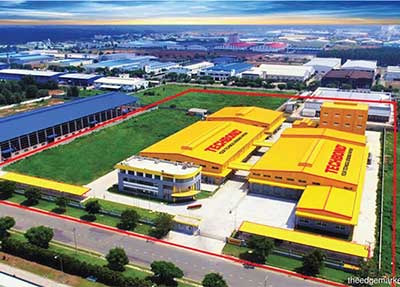
TECHBOND Group Bhd, a home-grown adhesives and sealants manufacturer, is moving upstream to produce polyvinyl acetate (PVA) polymer, a crucial ingredient for making industrial glues. And it is banking on its new polymerisation plant at the Vietnam-Singapore Industrial Park II-A (VSIP2) in Binh Duong, Vietnam, to be a game changer for the group, according to its deputy managing director Lee Seh Meng.
The new VSIP2 factory complex, which commenced operations in June, is the group’s third manufacturing facility and its second plant in Vietnam. Main Market-listed Techbond also has manufacturing facilities in Shah Alam, Selangor. Besides the polymerisation plant, Techbond’s VSIP2 factory complex also houses two water-based adhesives manufacturing lines, as well as two warehouses, an administration office and a quality control centre.
“About two years ago, we started constructing our second factory in Vietnam. Our polymerisation plant is already in commercial production. We have imported some PVA polymer (from Vietnam) to Malaysia to produce water-based adhesives here,” Lee tells The Edge in a virtual interview. Lee’s father Lee Seng Thye, who is managing director of Techbond, is the single largest shareholder in the group, with 72% equity interest.
Other prominent names among its top 30 shareholders as at Oct 20 last year were Avenue Portal Sdn Bhd, JAG Capital Equity Sdn Bhd, ACE Private Equity Sdn Bhd — a unit of financial services firm ACE Group — and three Hong Leong funds. JAG Capital Equity is an investment trading company wholly-owned by ACE Market-listed total waste management company JAG Bhd, while Avenue Portal is controlled by Datuk Ng Aik Kee.
Techbond’s polymerisation plant has an installed production capacity of 4,680 tonnes a year. About 30% of that is for its own raw material consumption, another 30% is for sale to customers — mainly polymer distributors and trading houses — and the remaining 40% used to develop new types of industrial adhesives.
Lee says the completion of the VSIP2 plant was delayed by the Covid-19 pandemic, resulting in a higher capital expenditure incurred. Including working capital, Techbond has invested about RM27 million in the new factory complex, which sits on land measuring 30,000 sq m and has a built-up area of about 7,000 sq m.
“Right now, our polymerisation plant is running at a 30% utilisation rate, and this capacity has been fully allocated for our internal use. We are already using our own polymer in our Vietnam and Malaysia operations. Previously, we purchased polymer from third-party suppliers. Compared to the prices that we [paid to them], our polymerisation plant in VSIP2 can give us an estimated savings of 20% of raw material cost,” he says.
Techbond’s new plant also enjoys full tax exemption on its income in the first two years, followed by a 50% reduction of tax payable in the subsequent four years.
Before the pandemic, the polymer business was estimated to contribute annual revenue of up to RM100 million to the group.
He notes that Techbond is, however, fortunate that it has a well-diversified customer portfolio geographically. Today, 75% of the group’s revenue is derived from overseas markets such as Indonesia, China and Cambodia.
